 Numbers + Letters
 QuickShip
 Plaques
 Decals
 Custom
 Trade
Trade


The feng shui front door is the "Mouth of Chi," the primary portal through which energy, opportunities, and abundance enter a home, and its color, direction, and condition determine the quality of that incoming energy.
This guide covers the front door's role as an energy portal, how to determine the best compass direction and corresponding colors, proper placement and curb appeal for smooth chi flow, the influence of house numbers and address visibility, hardware and decor choices, ongoing maintenance and protection cures, and adaptations for apartments and modern minimalist homes.
We start with the foundational concept of the Mouth of Chi, explaining why a well-maintained, unobstructed entrance invites positive energy while a neglected or blocked one causes stagnation, and how this single entry point affects wealth, health, and relationships throughout the household.
From there, we address direction and color together, since each compass orientation carries an elemental association (Water, Fire, Wood, Metal, or Earth) that dictates which door colors generate supportive energy versus which clash with it, while still leaving room for personal style.
Placement and curb appeal come next: we cover how the Mingtang, or "bright hall," should stay open, bright, and uncluttered just outside the door, how walkways and driveways should curve rather than aim straight at the entrance, and how lighting, landscaping, and materials complete an inviting approach.
We also examine how house numbers and address visibility function as a practical extension of feng shui, and we detail hardware, doormats, and auspicious symbols that support (rather than clutter) the entryway's energy.
Finally, we cover the maintenance habits and protective cures that keep an entrance energetically clear over time, along with practical adaptations for apartments, condos, and contemporary minimalist homes where traditional design isn't always possible.
What Does Feng Shui Say About the Front Door as the "Mouth of Chi"?

Feng shui identifies the front door as the Mouth of Chi, the primary portal through which energy, opportunities, and abundance enter a home. This section explains why the entrance shapes household energy, how it affects wealth, health, and relationships, and which common mistakes block positive chi.
Why Is the Front Door So Important for Feng Shui Energy Flow?
The front door is important for feng shui energy flow because it serves as the Mouth of Chi, the main entry point through which life force enters a home. Chi, or qi, is the fundamental life force flowing through every space, composed of yin and yang elements that must stay balanced to create harmony. According to FengShuied's Bright Hall resource, the condition and appearance of a front door directly shapes the quality of chi entering the home, so a well-maintained entrance invites positive energy while a neglected one restricts it. This entry point often gets overlooked, yet it sets the energetic tone for the entire household.
How Does Your Front Door Influence Wealth, Health, and Relationships?
Your front door influences wealth, health, and relationships by controlling how much chi reaches each area of the Bagua energy map linked to the entrance. Wealth corresponds to the areas chi first encounters upon entry, so a clear, welcoming doorway supports financial opportunity. Health ties to the overall vitality of incoming energy, meaning stagnant or blocked entries can leave occupants feeling drained. Relationships depend on smooth, balanced chi circulation, which encourages harmony between household members and guests. A door that sticks, squeaks, or sits in shadow disrupts all three areas simultaneously, since the entrance acts as the shared source for energy in the home. Prioritizing entry repairs typically delivers faster results than rearranging furniture elsewhere in the home.
What Common Front Door Feng Shui Mistakes Should You Avoid?
Common front door feng shui mistakes to avoid include neglecting maintenance, blocking the entry, and letting the space go dark. When the Mouth of Chi is compromised, whether through clutter, dim lighting, or poor upkeep, occupants are believed to experience stagnation, missed opportunities, and general misfortune. Frequent mistakes include:
- Leaving the door squeaky, sticking, or hard to open, which signals struggle to incoming chi.
- Allowing clutter, cobwebs, or trash near the entrance to accumulate.
- Using a dark, poorly lit entryway that makes the doorway hard to see or approach.
- Ignoring peeling paint, rust, or worn hardware that gives a neglected impression.
Fixing these details first sets the stage for choosing an auspicious door direction next.
How Do You Determine the Best Front Door Direction for Feng Shui?
The best front door direction for feng shui depends on your home's compass orientation, the Bagua map, and your personal Kua number. Finding the right direction requires accurate compass reading, understanding directional meanings, and balancing tradition with real-world design limits.
How Can You Find Your Front Door’s Compass Direction Accurately?
You can find your front door's compass direction accurately by standing in the doorway, facing outward, and reading a compass held flat at chest height. A smartphone compass app or a physical magnetic compass both work, provided the reading is taken away from metal objects, appliances, or large electronics that can skew results.
For the most reliable reading, follow these steps:
- Stand directly in the doorway facing outside, not inside the home.
- Hold the compass level and away from your body's metal accessories.
- Take three separate readings and average the results for accuracy.
- Round the final number to the nearest of the eight compass directions (N, NE, E, SE, S, SW, W, NW).
This directional reading becomes the foundation for interpreting your door's feng shui meaning.
What Does Each Front Door Direction Mean in Feng Shui?
Each front door direction in feng shui corresponds to a specific life area, element, color, and celestial animal drawn from the Bagua map. The Bagua, meaning "eight trigrams," is an octagonal energy map consisting of eight sections, and each section represents a distinct life area, direction, element, and color used to analyze how energy flows through a home.
Directional meaning in feng shui also draws on the four celestial animals, each tied to a cardinal point and seasonal energy:
- East carries the Azure Dragon, linked to the spring equinox and representing growth and new beginnings.
- South carries the Vermilion Bird, linked to the summer solstice and representing expansion and visibility.
- West carries the White Tiger, linked to the autumn equinox and representing contraction and protection.
- North carries the Black Tortoise, linked to the winter solstice and representing rest and foundation.
These celestial animals have been documented in feng shui practice since ancient times and continue to shape directional analysis in modern applications. The system itself is not a modern invention; it was formalized during imperial China, with the Han dynasty (206 BCE to 220 CE) onward marking widespread adoption in the imperial court. Directional feng shui reached its height under the Ming (1368-1644) and Qing (1644-1912) dynasties, when the Qintianjian, or Imperial Astronomical Bureau, employed dedicated feng shui consultants.
This imperial history explains why directional analysis carries such weight in feng shui today. It was never a casual guideline but a state-level discipline refined over centuries by professional consultants advising emperors.
How Should You Prioritize Direction Versus Practical Design Constraints?
You should prioritize practical design constraints first, then layer feng shui directional adjustments around them, rather than forcing a home's structure to match an ideal compass direction. Most homeowners cannot relocate a front door simply because it faces a less favorable direction, so feng shui practice offers remedies, such as color choices, lighting, and threshold treatments, that enhance chi flow regardless of orientation.
In practical experience, an overly rigid focus on "perfect" direction often causes homeowners to overlook simpler, higher-impact fixes like improving visibility, symmetry, and maintenance at the entry. Directional theory should inform design choices, not dictate a costly renovation. With direction established, attention naturally turns to selecting front door colors that complement that orientation.
What Are the Best Feng Shui Front Door Colors for Each Direction?

The best feng shui front door colors align with each direction's ruling element, since color carries elemental energy that supports or clashes with a home's orientation. Element cycles determine which colors strengthen chi, and personal style can still shine within these guidelines.
Which Front Door Colors Are Best for North, South, East, and West?
The best front door colors for North, South, East, and West are guided by each direction's ruling element in feng shui cosmology. The table below outlines the recommended palette for each cardinal direction:
|
Direction |
Ruling Element |
Recommended Colors |
|
North |
Water |
Black, blue |
|
South |
Fire |
Red |
|
East |
Wood |
Green |
|
West |
Metal |
White, silver, gold |
How Do Element Cycles Influence Your Front Door Color Choice?
Element cycles influence front door color choice by determining which colors generate, support, or weaken the energy tied to a home's direction. In the generative cycle, Water feeds Wood, Wood feeds Fire, Fire feeds Earth, Earth feeds Metal, and Metal feeds Water. In the destructive cycle, Wood depletes Earth, Earth absorbs Water, Water extinguishes Fire, Fire melts Metal, and Metal cuts Wood. A South-facing door, already ruled by Fire, benefits from red or orange because these colors reinforce existing energy rather than compete with it. Choosing a generative color over a destructive one is the detail most homeowners overlook, yet it often determines whether an entrance feels balanced.
How Can You Balance Personal Taste With Feng Shui Color Rules?
Personal taste can be balanced with feng shui color rules by treating direction-based colors as a starting palette rather than a rigid mandate. Feng shui itself is not monolithic; different schools of practice, informed by ancient references such as the Lo (River) Chart and the Yellow River Chart (Hetu), have historically produced varying Bagua configurations and color guidance, meaning even traditional practitioners disagree on exact shades. In practice, applying the correct element through an accent, such as trim, door hardware, or a nearby planter, satisfies the intent without forcing an unwanted paint color. This approach respects tradition while keeping curb appeal personal. With a color palette set, entrance placement determines how that energy flows inward.
How Should You Place and Design the Front Door for Smooth Energy Flow?
Good front door placement creates an open, well-lit path so chi can flow smoothly into the home. This means aligning the door with the entry path, avoiding direct sightlines to streets, and correcting problem layouts with simple design fixes.
What Makes an Ideal Front Door Location and Alignment in Feng Shui?
The ideal front door location and alignment in feng shui centers on the Mingtang, or "bright hall," the open space immediately outside and inside the entrance. This space should stay clean, uncluttered, and well-lit, allowing chi to gather before circulating into the home. A door set too close to a wall, fence, or steep slope restricts this gathering space and weakens incoming energy. Ideally, the entry sits at a natural focal point of the property, with enough clearance for chi to pool and settle rather than rush past. Symmetry around the doorway also supports balanced energy flow, whereas a cramped, shadowed, or off-center entrance disrupts it.
How Should Your Front Door Relate to Driveways, Walkways, and Streets?
Your front door should relate to driveways, walkways, and streets through a gentle, curving approach rather than a straight, fast-moving line. A walkway that runs directly from the street to the door in one rigid line lets chi rush past the entrance instead of settling into the home. Curved or gently winding paths slow this energy down, giving it time to gather in the Mingtang before entering. Driveways aimed straight at the front door create a similar rushing effect. Softening this alignment with landscaping, a bend in the path, or staggered pavers helps redirect the flow. Streets that dead-end directly into the entrance present the same challenge and benefit from the same corrective approach.
How Can You Correct Challenging Placements Like Side Entries or Long Corridors?
You can correct challenging placements like side entries or long corridors by adding visual and physical cues that redirect chi toward the main entrance. Side entries, where the true front door sits off to one side of the home's facade, benefit from clear lighting and signage that draws attention toward the correct door. Long, narrow corridors tend to funnel chi too quickly, creating a rushed, unsettled feeling inside. Common corrective measures include:
- Adding a well-lit house number or marker near the true entry point to guide visitors and chi toward it.
- Placing mirrors along a long corridor to visually widen the space and slow the energy's pace.
- Adding plants or lighting fixtures partway down a corridor to create resting points for chi.
- Using a rug or pathway marker to break up a straight, narrow approach.
With placement and flow addressed, curb appeal details reinforce that welcoming energy.
How Can You Improve Front Door Curb Appeal to Attract Positive Chi?
Front door curb appeal improves through intentional design choices, such as balanced entryway proportions, quality materials, functional lighting, and well-tended landscaping. These elements work together to welcome positive chi into the home. The sections below cover guiding principles, lighting and landscaping, and materials and hardware.
What Feng Shui Principles Guide an Inviting Front Entry Design?
Feng shui principles for an inviting front entry emphasize alignment, balance, and unobstructed flow. These principles date back thousands of years and remain consistent across architectural scales, from imperial palaces to residential homes.
The Forbidden City in Beijing offers the clearest historical example. Its designers applied a precise north-south axial alignment to optimize chi flow through the entire complex. This axial approach illustrates a core principle homeowners can scale down: a front entry should feel centered, aligned, and free of visual obstruction along its main approach.
Applied to a modern home, this means:
- Keeping the entry path straight or gently curved rather than sharply angled.
- Centering the door within its surrounding facade elements where possible.
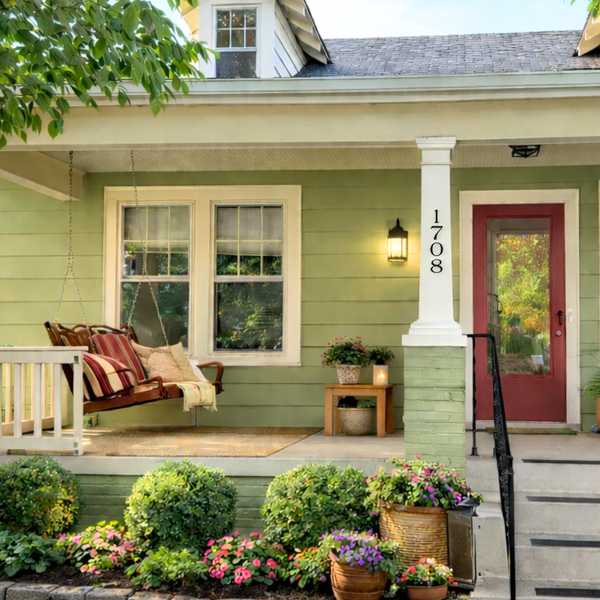
- Avoiding structural clutter, such as overgrown shrubs or stacked furniture, near the threshold.
Symmetry and clear sightlines translate imperial-scale feng shui into practical, everyday entry design.
How Should Lighting, Landscaping, and Pathways Support Good Energy?
Lighting, landscaping, and pathways support good energy by keeping the entry area bright, open, and welcoming. This space corresponds to the Mingtang, or "bright hall," the buffer zone just outside the front door where incoming chi gathers before entering the home.
Ideally, the Mingtang should be large, bright, clean, and sheltered from harsh elements. Practitioners recommend maintaining symmetry, adding living plants, and ensuring adequate lighting in this area. Applied practically, this guidance points to several concrete actions:
- Install adequate lighting, such as sconces or path lights, so the entry stays visible after dark.
- Add living plants in matched, symmetrical planters flanking the door.
- Keep pathways clear, level, and shielded from wind or excessive sun exposure.
Symmetrical plantings and consistent lighting do more than look tidy; they also signal a well-maintained, energetically balanced approach to visitors and, per feng shui belief, to incoming chi.
How Do Materials, Hardware, and House Numbers Affect First Impressions?
Materials, hardware, and house numbers affect first impressions by shaping the immediate visual quality of the entry before anyone reaches the door. Durable materials and clean signage signal order and care, both of which feng shui philosophy associates with well-managed chi flow.
Practical priorities for this layer of curb appeal include:
- Choosing solid, weather-resistant materials, such as aluminum, over items that fade or corrode.
- Selecting hardware finishes that complement the door color and surrounding architecture.
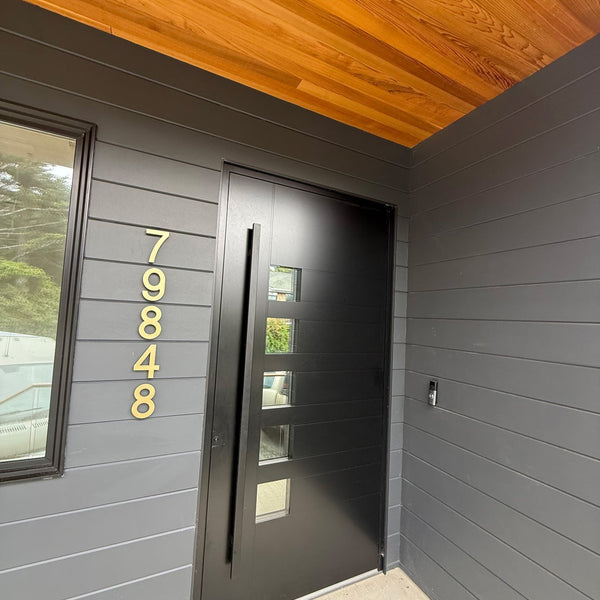
- Displaying house numbers that are clean, legible, and proportionate to the facade.
Modern House Numbers designs handcrafted aluminum house numbers that stay legible and rust-free for years, giving homeowners a durable, architecturally consistent finishing touch for this part of the entry. Well-chosen materials and clear signage complete the inviting entry feng shui principles call for.
How Do House Numbers and Address Visibility Affect Feng Shui Energy?

House numbers and address visibility affect feng shui energy by signaling a well-maintained, energetically balanced approach to visitors and, per feng shui belief, to incoming chi. Clear numbering, thoughtful style, and correct placement all shape this flow of energy.
Why Does Clear, Visible House Numbering Matter in Feng Shui?
Clear, visible house numbering matters in feng shui because it guides chi, opportunities, and abundance directly to the front door. Since the entrance functions as the Mouth of Chi, a hidden, faded, or obstructed address is associated with missed opportunities and stagnant fortune.
Visibility also carries a practical dimension that reinforces the energetic one. Emergency responders, guests, and delivery services rely on legible numbers, and a home that is easy to find naturally feels more welcoming and prosperous. This dual function, energetic and practical, makes address visibility one of the simplest yet most overlooked feng shui upgrades a homeowner can make.
Address visibility is one of the most underrated feng shui fixes because it delivers immediate curb appeal benefits alongside symbolic ones.
How Can the Style, Size, and Placement of House Numbers Influence Chi?
The style, size, and placement of house numbers influence chi by signaling a well-maintained, balanced energy. Numbers that are too small, ornate, or poorly proportioned to the facade can signal clutter that invites negative chi, while clean, well-sized numerals support a steady, legible flow toward the door.
Placement also connects to directional analysis within feng shui. The Compass School, known as Ba Zhai or Eight Mansions, uses a magnetic compass to determine auspicious directions and placements. This school classifies houses into eight types based on the compass direction they face and calculates personal Kua numbers for occupants based on birth year and gender. Because house numbers typically sit near the entrance, their position interacts with the same directional data used to evaluate the door itself.
From a design standpoint, numerals crafted from durable, substantial materials, such as solid aluminum, tend to project stability and permanence, qualities that align well with grounded, auspicious chi.
Where Should You Mount House Numbers for Optimal Energy and Practicality?
House numbers should be mounted at eye level near the front entrance, in a location unobstructed by plants, shadows, or architectural features, for optimal energy and practicality. This placement keeps the address within the Mingtang, the bright, open zone just outside the door where chi is meant to gather before entering the home.
Consider these mounting guidelines:
- Position numbers on a well-lit wall segment or beside the door, never behind foliage or fixtures.
- Choose contrasting colors or finishes so numerals stand out against the facade both day and night.
- Avoid mounting numbers on gates, mailboxes, or curbs alone if the front door itself lacks visible identification.
- Keep numbers proportionate to the home's scale so they are legible from the street.
A well-placed, legible address is a small detail with outsized influence on how confidently chi, and visitors, arrive at your door.
How Can You Choose Front Door Hardware, Fixtures, and Décor With Good Chi?
Front door hardware, fixtures, and décor support good chi when they are clean, functional, and made from quality materials such as aluminum. This section covers handles and knockers, doormats and planters, and auspicious symbols and shapes.
What Types of Door Handles, Knockers, and Mail Slots Support Feng Shui?
The types of door handles, knockers, and mail slots that support feng shui are smooth, rounded, and made from quality metal such as aluminum, which align with the metal element and its wealth associations. Sharp or jagged hardware is thought to create cutting energy that disrupts incoming chi.
Supportive hardware choices include:
- Round or lever handles in matte brass or matte black finishes
- Ring-style knockers in warm metal finishes
- Flush-mounted mail slots with tight, gap-free covers
- Rust-free hinges and locks that operate smoothly
Worn, squeaky, or mismatched hardware is an easy mistake to overlook, yet it undercuts even a well-designed entry.
How Should You Use Doormats, Planters, and Décor Without Cluttering Energy?
Doormats, planters, and décor should be used sparingly, kept clean, and arranged so they never block the path chi travels through the entryway. A single well-maintained doormat, replaced when frayed, is preferable to layering multiple mats that trap dirt and stagnant energy.
Planters work best in symmetrical pairs flanking the door, filled with healthy, thriving plants rather than dried or wilting ones, since dying greenery is believed to signal fading opportunity. Décor such as seasonal wreaths or small statues should be limited to one or two pieces so the entrance stays open and uncluttered.
In practice, less is more: an entry crowded with mismatched planters, mats, and ornaments works against the very energy homeowners are trying to invite in.
Which Symbols and Shapes Are Considered Auspicious at the Front Door?
The symbols and shapes considered auspicious at the front door are curved or rounded forms, such as arched thresholds, oval planters, and circular wreaths, which are thought to invite chi to flow gently rather than strike the entry directly. Sharp, pointed, or arrow-like shapes aimed at the doorway are generally avoided, since they are believed to direct detrimental chi directly at you.
Common auspicious symbols include:
- Round or oval wreaths and mirrors for gentle, protective energy
- Pairs of guardian figures, such as lions or foo dogs, for protection
- Fish or koi motifs, associated with abundance
- Small red accents, tied to the Fire element and good fortune
Bagua mirrors are a traditional protective symbol, but they should face outward only and be used thoughtfully, as pointing one at a neighbor's door is considered inappropriate. With inviting hardware and symbols in place, keeping the entry clear protects that energy long term.
How Do You Keep the Front Door Area Energetically Clear and Protected?
Keeping the front door energetically clear requires consistent maintenance, protective cures, and regular refreshing. The sections below cover harmful habits to avoid, protection tools like mirrors and plants, and how often to refresh your entry.
What Clutter and Maintenance Habits Harm Front Door Feng Shui?
Clutter and neglect harm front door feng shui by blocking the Mouth of Chi, the primary portal through which energy, opportunities, and abundance enter a home. When this entry point becomes cluttered, dark, or poorly maintained, occupants are believed to experience stagnation, missed opportunities, and general misfortune.
Common habits that damage front door energy include:
- Leaving shoes, umbrellas, or boxes piled near the entrance
- Allowing cobwebs, dirt, or dead leaves to accumulate on the doorstep
- Letting paint peel or hardware rust without repair
- Storing trash bins or recycling directly beside the door
- Permitting a burnt-out porch light to go unfixed
A neglected entrance restricts beneficial energy flow, while a well-maintained one invites it in. In practice, treating the entryway with the same care given to interior living spaces is one of the simplest ways to protect a home's energetic health.
How Can You Use Protection Cures Like Mirrors, Plants, or Lighting?
You can use protection cures like mirrors, plants, or lighting to shield the entry and support the Mingtang, the open "bright hall" space just outside or inside the front door. This buffer zone should stay clean, uncluttered, and well-lit so chi can gather and circulate smoothly into the home.
Effective cures for the front entry include:
- Mirrors: Small, well-placed mirrors can deflect negative energy from sharp angles or oncoming pathways, though they should never directly face the door.
- Living plants: Healthy greenery near the entrance supports symmetry and vitality within the Mingtang.
- Lighting: Bright, consistent lighting keeps the bright hall large, clean, and sheltered in spirit, even in small spaces.
Practitioners recommend maintaining symmetry alongside these cures for a balanced, welcoming threshold. In practical terms, pairing a well-lit entry with a single healthy plant is often more effective than layering multiple cures, since simplicity keeps the Mingtang from feeling crowded again.
How Often Should You Refresh Your Front Entry for Energetic Health?
You should refresh your front entry seasonally or annually to sustain the energetic health of the Mouth of Chi. Because this space is the primary channel through which opportunities and abundance enter the home, allowing it to stagnate between refreshes undermines the benefits of any cures already in place.
Practical refresh habits include:
- Sweeping the doorstep and clearing cobwebs every week
- Replacing dead or dying plants promptly
- Wiping down door hardware and glass monthly
- Checking and replacing porch lighting as soon as it dims or fails
Consistent upkeep, rather than a one-time fix, keeps chi flowing steadily into the home. With clutter cleared and cures in place, well-designed house numbers help complete a protected, welcoming entry.
How Can Apartment, Condo, and Townhome Entrances Follow Feng Shui?
Apartment, condo, and townhome entrances can follow feng shui by adapting chi-flow principles to shared, interior, and multi-level layouts. Since full control over direction or design is rare, this section covers shared-entrance challenges, hallway and upstairs door enhancements, and renter-friendly adjustments for better door energy.
What Unique Feng Shui Challenges Exist for Shared or Interior Entrances?
Unique feng shui challenges for shared or interior entrances include diluted Mouth of Chi energy, limited access to a private Mingtang, and restricted control over color or hardware. Interior units without a direct outdoor threshold cannot create the open, sheltered Mingtang buffer that ground-floor homes enjoy naturally. Additionally, HOA rules, landlord policies, and shared walls often prevent residents from repainting a door or changing its direction to match personal Kua numbers. These constraints mean feng shui adjustments must work within, rather than against, the existing structure.
How Can You Enhance a Front Door in a Hallway or Upstairs Unit?
A front door in a hallway or upstairs unit can be enhanced by adding lighting, mirrors, and a distinct, personal touch that helps the entrance stand out from neighboring doors. Bright, warm lighting compensates for the lack of natural sunlight typical in interior corridors and helps circulate stalled chi. A doormat, small plant, or seasonal wreath gives an upstairs or hallway entrance its own identity within a row of identical doors, which practitioners consider important for claiming and activating personal energy. For units at the end of a long corridor, a wind chime or piece of art near the threshold can slow rushing chi before it reaches the door.
What Small, Renter-Friendly Adjustments Support Better Door Energy?
Small, renter-friendly adjustments that support better door energy include options requiring no drilling or paint. Renters and condo owners with limited flexibility can try:
- A removable, textured doormat to define the threshold.
- A battery-powered light to brighten a dim hallway.
- A small potted plant near the door for living energy.
- Peel-and-stick address numbers or decals for a personal touch.
Keeping the doorway free of shoes and clutter remains the simplest way to support good energy in a rented space. These adjustable touches translate well to modern, minimalist entrance designs too.
How Should You Adapt Feng Shui Front Door Tips for Modern and Minimalist Homes?

Modern and minimalist homes can honor feng shui principles by translating traditional symbolism into contemporary materials and forms. The following sections cover honoring tradition within contemporary architecture, blending clean lines with welcoming energy, and using color, numbers, and signage subtly.
How Can Contemporary Architecture Still Honor Traditional Feng Shui?
Contemporary architecture can honor traditional feng shui by applying the Five Elements framework to modern materials instead of literal historical forms. The Five Elements system has been in use since the second or first century BCE during the Han dynasty, appearing across traditional Chinese medicine, music, martial arts, astrology, and feng shui practice. This long history shows that feng shui was never tied to one architectural style; it adapted across dynasties and disciplines.
Minimalist homes can apply this same adaptability. Concrete and stone represent Earth, glass and mirrors represent Water, and steel accents represent Metal, allowing sleek exteriors to carry elemental balance without ornamentation. This approach lets a flat-roofed, glass-walled home express the same principles as a traditional courtyard house. The lesson from feng shui's long adaptability is that symbolism matters more than style, which is good news for owners of minimalist or industrial-style homes.
What Design Choices Help Blend Clean Lines With Warm, Welcoming Energy?
Design choices that blend clean lines with welcoming energy include selecting materials and colors that represent the Five Elements while keeping forms simple. The Five Elements, or Wuxing, represent five fundamental phases of energy transformation and interaction: Wood, Fire, Earth, Metal, and Water. Each element carries specific characteristics, associations, and relationships with the others, and pairing complementary elements at the entry helps soften a minimalist facade's severity.
There are several ways to introduce warmth without clutter, such as:
- Adding a Wood-element piece like a light wood bench or planter box near the entry.
- Introducing Fire-element warmth through a single well-placed exterior sconce or lantern.
- Using Earth-toned stone or concrete planters to ground a glass-heavy facade.
- Incorporating a small metal accent, such as a recycled aluminum address plaque, to add clarity and precision.
Balancing even two elements at the entry can transform a stark, minimalist facade into a space that still feels inviting. Many minimalist homeowners over-correct toward austerity, but a single grounding element (like a Wood or Fire accent) is usually enough.
How Can You Use Color, Numbers, and Signage Subtly in Modern Exteriors?
Color, numbers, and signage can be used subtly in modern exteriors by choosing muted elemental tones and understated materials instead of bold traditional hues. A matte black or dark bronze house number set, for example, carries metal-element energy without disrupting a minimalist palette, while a warm-toned plaque introduces wood-element balance against concrete or stucco.
Subtlety works best when it stays purposeful rather than decorative. A well-placed, legible house number does double duty: it supports the "Mouth of Chi" by keeping the entrance clear and identifiable, and it satisfies feng shui's emphasis on order and visibility. Modern House Numbers designs address signage with this exact balance in mind, offering clean, architectural fonts and finishes that read as intentional design choices rather than afterthoughts, letting homeowners honor feng shui subtly while keeping a distinctly modern exterior.
How Should You Approach Feng Shui Front Doors With Modern House Numbers Products?
Feng shui front doors benefit from house numbers that are clean, legible, and well-placed at the Mouth of Chi. The sections below cover signage support for energy flow and key feng shui takeaways.
How Can Modern House Numbers Signage Support Good Front Door Feng Shui?

Modern house numbers signage supports good front door feng shui by keeping the entrance, the Mouth of Chi, clear, legible, and energetically balanced. Since the front door is the primary portal through which chi, opportunities, and abundance enter a home, any signage placed near it should enhance rather than obstruct that flow. Numbers that are dark, tarnished, crooked, or hard to read create the kind of visual clutter that practitioners associate with stagnant energy and blocked opportunity.
Modern House Numbers addresses this directly through architect-designed, handcrafted aluminum numbers that prioritize clean lines and balanced proportions, qualities that align naturally with feng shui's emphasis on order at the entryway. Each set is precision-crafted to order rather than mass-produced, so homeowners can select a finish and font that complements their door's color and their home's directional orientation without disrupting the Mingtang, or bright hall, just outside the entrance.
In practice, well-designed signage does double duty: it satisfies feng shui's call for a clear, uncluttered threshold while also solving the practical need for visible addressing. This dual function is often overlooked, but it is one of the easiest, lowest-cost ways to improve chi flow at the door.
What Are the Key Takeaways About Feng Shui Front Door Colors, Directions, and Placement for Good Energy?
The key takeaways about feng shui front door colors, directions, and placement are that the entrance functions as the Mouth of Chi, the primary channel through which energy enters the home, and its condition directly shapes the quality of that energy. A well-maintained, clear entrance invites positive chi, while a cluttered or neglected one restricts it.
The core principles to remember include:
- Color should align with the door's compass direction and the Five Elements (Wood, Fire, Earth, Metal, Water), since each element carries distinct associations that either support or clash with directional energy.
- Direction matters because each cardinal point corresponds to a celestial animal and seasonal energy, influencing how chi enters the home.
- Placement should keep the Mingtang, the space just outside the door, clean, bright, and uncluttered to let energy gather and circulate.
- Signage and hardware, including house numbers, should stay legible, symmetrical, and well-lit to avoid disrupting the entry's energetic flow.
Treating the front door as a complete system, rather than isolated color or direction choices, produces the most consistent results. Thoughtfully chosen house numbers from Modern House Numbers can serve as the finishing detail that ties these principles together at the entrance.