 Numbers + Letters
 QuickShip
 Plaques
 Decals
 Custom
 Trade
Trade


House numbers are standardized numerical identifiers assigned to buildings along a street, enabling mail delivery, emergency response, and civic administration. Their origins trace back centuries, from fifteenth-century Paris to eighteenth-century changes across Europe.
We cover the ancient roots and governmental catalysts behind early numbering systems, how different countries developed distinct approaches to address logic, the materials and design movements that shaped house number aesthetics, the critical role house numbers play in safety and property value, and how sustainability and modern craftsmanship are redefining house numbers today.
Before formal numbering existed, civilizations relied on house names, guild signs, and heraldic symbols to identify dwellings. Governments introduced numerical systems to serve military, census, and tax needs; Prague's red conscription plaques appeared around 1770, while Paris numbered 68 houses on the Pont Notre-Dame as early as the fifteenth century.
Numbering conventions vary dramatically worldwide. Philadelphia pioneered the odd-even street division around 1790, Japan developed a block-based system rooted in Edo-period geography, and rural American routes evolved separately from urban grids as the U.S. Postal Service expanded.
Materials shifted from hand-painted signs and plaster in the eighteenth century to mass-produced cast iron and enamel plaques by the nineteenth century. Movements like Bauhaus brought functionalist aesthetics to architectural hardware, influencing the clean, minimalist styles we recognize today.
Visible house numbers reduce emergency response times by up to 60%, and strong curb appeal can increase a home's sale price by 7% or more. These practical and financial stakes make thoughtful number selection a meaningful decision for any homeowner.
Recycled aluminum and sustainable manufacturing now drive the next chapter of house number production, while architect-designed, handcrafted pieces reflect a growing demand for quality over mass production.
When Did House Numbers First Begin to Be Used and Why?
House numbers first began to be used in the fifteenth century, when 68 houses were numbered on the Pont Notre-Dame in Paris for administrative identification. The subsections below explore how societies identified dwellings before numbering and what forces drove formal adoption.
How Did Early Societies Identify Dwellings Before House Numbers?
Early societies identified dwellings before house numbers through names, signs, and symbols tied to the occupant's identity. According to a Cambridge University Press study on urban history, the primary purpose of house names and signs in early modern European cities was to mark the individual, family, or ethnic identity of the owner or tenant; these identifiers changed in character during the eighteenth century before nearly disappearing from city centers by the mid-nineteenth century.
When names alone proved insufficient for growing administrative needs, numbering emerged as a solution. The first known instance dates to fifteenth-century Paris, where 68 houses on the Pont Notre-Dame received numbers to serve police, military, census, and tax administration. Accurate addressing remains critical today: the USPS uses Informed Visibility data to identify mail flow failures, with visible house numbering a primary factor in reducing delivery errors.
What Factors Led to the Initial Adoption of House Numbering Systems?

The factors that led to the initial adoption of house numbering systems were military recruitment, census administration, and centralized governance. In Prague, descriptive house numbers represented by red plaques date back to around 1770, introduced by order of Empress Maria Theresa as "conscription numbers" to facilitate military enrollment and population counts.
Other key drivers included:
-
An ordinance dated August 30, 1780, in Paris led to significant urban changes, including the demolition of the Petit Châtelet, coinciding with broader adoption of house numbering across the city.
-
Philadelphia devised the rule of separating odd and even numbers on opposite sides of each street when the first federal census was conducted in 1790.
-
The shift from hand-painted signs and plaster surfaces in the eighteenth century to mass-produced cast iron and enamel plaques in the nineteenth century made numbering permanent and scalable.
These practical needs, from tracking citizens to organizing mail, transformed house numbers from a bureaucratic tool into a universal urban standard still shaping how addresses function today.
How Did House Numbering Systems Evolve Across Different Countries and Cultures?
House numbering systems evolved across different countries and cultures through distinct regional approaches shaped by local governance, geography, and urban planning traditions. The subsections below examine specific global variations and the role urbanization played in standardizing these systems.
What Variations Exist in Global House Numbering Practices?
The variations that exist in global house numbering practices range from sequential street-side systems to block-based addressing methods. The odd-even convention, where odd and even numbers appear on opposite sides of a street, was first devised in Philadelphia during the first federal census in 1790, according to historian Anton Tantner's research published through OpenEdition.
Japan uses a fundamentally different model. The Japanese addressing system, which evolved from Edo-period town names, assigns addresses based on blocks rather than streets; houses are often numbered in the order they were built within a block (banchi). Meanwhile, rural route numbers in the United States were developed specifically for residences outside city limits, reflecting the country's vast non-urban geography.
These contrasting approaches reveal that no single "correct" system exists. Each method emerged from the specific administrative, cultural, and geographic needs of its region.
How Did Urbanization Influence the Spread and Standardization of House Numbers?
Urbanization influenced the spread and standardization of house numbers by concentrating populations in ways that made informal identification methods impractical. According to data from the National Bureau of Economic Research, 83 percent of the U.S. population lived in rural areas in 1800, but the century's increasingly urban manufacturing character created a direct correlation between urban density and the need for standardized numbering.
As cities grew, postal delivery, emergency services, and tax collection all demanded reliable address systems. Dense neighborhoods could no longer rely on landmarks or personal familiarity to locate individual dwellings. Standardized house numbering became essential municipal infrastructure, not merely an administrative convenience.
This shift from optional identification to required civic infrastructure set the stage for the material and design innovations that would transform house numbers into architectural statements.
What Materials and Design Trends Have Shaped the Appearance of House Numbers Over Time?
The materials and design trends that shaped house numbers over time range from hand-painted signs and cast iron plaques to architect-designed aluminum numbers influenced by modernist movements. The subsections below cover manufacturing technology and architectural aesthetics.
How Did Technological Advances Affect House Number Manufacturing?
Technological advances affected house number manufacturing by shifting production from handcrafted, one-off signage to standardized, mass-produced plaques as industrial methods matured. According to Springer, the industrial production of cast iron using patterns prepared from plastics, wood, or metal became prominent in the 16th century, eventually leading to durable cast iron house number plaques across European cities.
This shift accelerated alongside urbanization. In 1800, 83 percent of the U.S. population lived in rural areas, yet rapid urban growth throughout the century created direct demand for standardized numbering systems. As cities densified, hand-painted signs proved impractical at scale; factories began producing uniform enamel and cast iron numerals that could be installed quickly across entire neighborhoods.
Governmental mandates further drove manufacturing needs. When King Louis XV issued a decree on March 1, 1768, requiring all houses outside Paris to receive assigned numbers, production capacity had to meet sudden, large-scale demand. Similar pressures emerged globally, including Japan's block-based addressing system that evolved from Edo-period town names, where houses are numbered in the order they were built within a block. Each cultural approach demanded region-specific manufacturing solutions, pushing material innovation forward across centuries.
What Role Did Architecture and Design Aesthetics Play in House Number Styles?

Architecture and design aesthetics played a defining role in house number styles by tying numeral form directly to the visual language of each era's dominant movement. Bauhaus design, established in 1919, rejected artistic elitism in favor of craftsmanship and functionalism, according to Walter Gropius. That philosophy reshaped house number aesthetics by prioritizing clean geometry, legible sans-serif typefaces, and minimal ornamentation.
Mid-century modern architecture extended this influence, pairing textured surfaces with ribbon windows and functional minimalism. House numbers from this period adopted sleek profiles and restrained proportions that complemented rather than competed with the facade. The result was a shift from decorative Victorian numerals toward understated, architecturally integrated designs.
For homeowners today, this legacy means that selecting house numbers is as much a design decision as choosing exterior paint or hardware. Understanding which aesthetic movement a home reflects helps narrow the right style, whether that is a bold Palm Springs font or a refined contemporary silhouette.
Why Are House Numbers Important for Safety, Navigation, and Community Identity?
House numbers are important for safety, navigation, and community identity because they enable emergency responders to locate addresses quickly, help delivery services operate efficiently, and contribute to a home's visual character. The sections below cover emergency response impact and curb appeal value.
How Do House Numbers Impact Emergency Response and Delivery Services?
House numbers impact emergency response and delivery services by providing the visible address identification that first responders and logistics carriers depend on to reach the correct location without delay. When numbers are missing, obscured, or illegible, precious minutes are lost during medical emergencies, fire calls, and package deliveries.
According to Glomensio, clear, readable, and properly placed house numbers can reduce emergency response times by up to 60%, a critical factor given that cardiac arrest survival drops 7–10% for every minute of delay. Beyond emergencies, accurate house numbering reduces misdelivered mail, failed package attempts, and the administrative costs associated with correcting routing errors. Investing in high-contrast, well-positioned address numbers is one of the simplest upgrades a homeowner can make to protect both their household and their neighborhood.
In What Ways Do House Numbers Contribute to a Home's Curb Appeal?

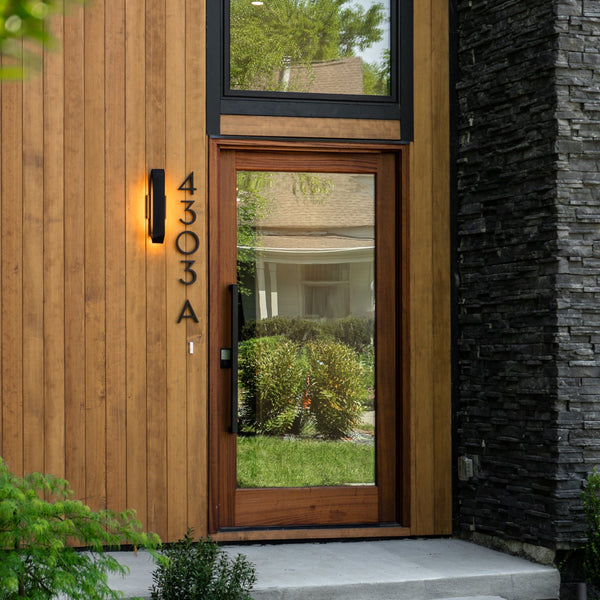
House numbers contribute to a home's curb appeal by serving as one of the first design details visitors and potential buyers notice from the street. Font style, material finish, and mounting placement all shape the visual impression a home creates.
The financial impact is measurable. A RE/MAX study revealed that homes with appealing exteriors sell for an average of 7% more than comparable homes with less attractive facades. Well-maintained exterior details, including address signage, can increase a home's value by up to 10% while helping it sell faster. For homeowners weighing where to invest, replacing outdated or generic house numbers with architect-designed alternatives offers an outsized return relative to cost. Thoughtfully chosen numbers unify a home's exterior palette and signal that every detail has been considered, making curb appeal both an aesthetic and a financial asset.
How Have Sustainable Practices and Modern Design Transformed House Numbers Today?
Sustainable practices and modern design have transformed house numbers today by shifting materials toward recycled metals, reducing environmental impact, and aligning address signage with contemporary architectural styles. The following sections cover recycled material benefits and current design trends.
What Are the Environmental Benefits of Using Recycled Materials for House Numbers?
The environmental benefits of using recycled materials for house numbers include reduced landfill waste, lower energy consumption during manufacturing, and a smaller carbon footprint compared to virgin metal production. Recycled aluminum, the most common sustainable option, requires roughly 95% less energy to process than newly mined aluminum.
According to Cognitive Market Research, the global recycled aluminum market size is estimated at USD 52.6 billion in 2025 and is expanding at a compound annual growth rate as manufacturers shift toward sustainable materials for architectural hardware. Key environmental advantages include:
-
Diverting post-consumer metal from landfills into durable, long-lasting products.
-
Significantly reducing greenhouse gas emissions tied to primary aluminum smelting.
-
Supporting closed-loop manufacturing where old products become raw material for new ones.
-
Minimizing resource extraction and its associated habitat disruption.
For homeowners, choosing house numbers made from recycled aluminum is one of the simplest ways to incorporate sustainability into exterior design without sacrificing durability or appearance.
How Do Contemporary House Numbers Reflect Current Architectural Trends?
Contemporary house numbers reflect current architectural trends by embracing clean geometry, minimalist typography, and material honesty. Modern residential design favors uncluttered facades where every visible element serves both a functional and aesthetic purpose, and address signage is no exception.
Several defining characteristics connect today's house numbers to broader design movements:
-
Minimalist forms: Sans-serif typefaces and slim profiles echo the simplicity prioritized in contemporary and mid-century modern architecture.
-
Material transparency: Exposed brushed or powder-coated metals celebrate the raw quality of the material rather than concealing it.
-
Floating mount installation: Standoff hardware creates shadow lines that add depth, a technique borrowed from modern sculptural design.
-
Customization: Made-to-order fabrication allows homeowners to match numbers precisely to their home's color palette, scale, and style.
This convergence of form and function means house numbers now operate as intentional design elements rather than afterthoughts. With sustainability and architectural intention guiding today's choices, selecting the right house numbers becomes a meaningful extension of a home's overall identity.
How Can Architect-Designed, Handcrafted House Numbers Enhance the Value and Style of Your Home?
Architect-designed, handcrafted house numbers enhance the value and style of your home by combining architectural expertise with durable, sustainable materials that elevate curb appeal. The sections below explore what makes Modern House Numbers unique and the key takeaways from the history we covered.
What Makes Modern House Numbers' Approach to Design and Craftsmanship Unique?

Modern House Numbers' approach to design and craftsmanship is unique because every product is architect-designed and handcrafted to order in Tucson, Arizona, rather than mass-produced. Founded in 2008 by architects Brandy and Rick McLain, the company draws on professional backgrounds in architecture and urban planning to create address signs from solid, recycled, ⅜-inch thick aluminum. This made-to-order process minimizes waste while ensuring each piece meets architectural-quality standards. Free personalized drilling templates and concealed hardware accompany every order, delivering worry-free installation. For homeowners and design professionals alike, this combination of design expertise, sustainable materials, and individualized craftsmanship transforms a simple address marker into a lasting architectural detail.
What Are the Key Takeaways About the History and Evolution of House Numbers We Covered?
The key takeaways about the history and evolution of house numbers we covered span identification, standardization, safety, and design. Before numbering existed, early European cities relied on house names and signs to mark individual or family identity, a practice that nearly vanished by the mid-nineteenth century, according to research published in Cambridge University Press's Urban History journal. Government mandates for military and census needs drove formal adoption across Europe. Urbanization then demanded standardized systems worldwide. Materials progressed from hand-painted signs to cast iron, enamel, and today's recycled aluminum. Throughout this evolution, house numbers have consistently served public safety, delivery efficiency, and curb appeal, bridging centuries of functional necessity with modern architectural expression.