 Numbers + Letters
 QuickShip
 Plaques
 Decals
 Custom
 Trade
Trade


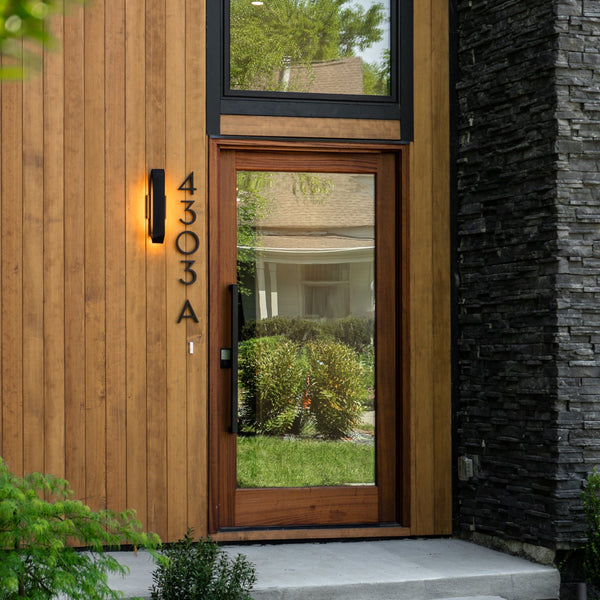
Alphanumeric house numbers are address identifiers that combine letters with numerals, such as "12A" or "B-204," to distinguish units, subdivisions, or properties where standard numbering alone falls short. They serve both a functional wayfinding role and a design opportunity for homeowners seeking a distinctive exterior.
This guide covers what alphanumeric addresses are and why they work, material selection for longevity and sustainability, design principles for style and legibility, installation methods, regulatory and HOA compliance, and how architect-designed craftsmanship from Modern House Numbers brings it all together.
Alphanumeric formats differ from purely numeric addresses by adding a layer of specificity; properties with secondary units, corner lots, or infill builds often require letter-number combinations to meet municipal identification standards. The design flexibility of pairing letters and numbers also opens creative possibilities that simple numerals cannot achieve.
Choosing the right material determines how well your house numbers withstand years of sun, rain, and temperature swings. Metals like aluminum resist rust and endure harsh weather without degrading, while recycled options offer the same durability with a lower environmental footprint.
Effective design balances aesthetics with readability. Sans-serif fonts maintain legibility at distance, and proper sizing (generally one inch of letter height per ten feet of viewing distance) ensures your address is visible from the street. Color contrast and finish selection let you align house numbers with your home's architectural style.
Installation requires basic tools: a drill, level, tape measure, and appropriate fasteners for your wall surface. Correct alignment and secure mounting protect both appearance and longevity.
Local building codes and HOA rules vary widely across the United States, with municipalities setting specific height minimums, stroke widths, and placement requirements that homeowners must verify before installation.
Modern House Numbers offers architect-designed, made-to-order alphanumeric signage and decals crafted to meet both code standards and contemporary design expectations.
What Are Alphanumeric House Numbers and Why Choose Them?

Alphanumeric house numbers are address identifiers that combine both letters and numbers, such as 12A, 4B, or 221B. The following sections explain how they differ from traditional numeric addresses and the design advantages they offer.
How Do Alphanumeric House Numbers Differ from Traditional Numeric Ones?
Alphanumeric house numbers differ from traditional numeric ones by incorporating alphabetical letters alongside standard digits. Traditional addresses rely solely on sequential numbers (101, 102, 103), while alphanumeric formats use letter suffixes or prefixes to distinguish subdivided properties, accessory dwelling units, or multi-unit buildings. An address like 45A and 45B identifies two distinct residences sharing a single numeric assignment.
According to the International Residential Code (IRC) Section R319.1, address characters must be plainly legible and visible from the street, using Arabic numbers or alphabetical letters with contrasting backgrounds. This confirms that building codes formally recognize both formats as valid address identification. For homeowners with subdivided lots or additions, alphanumeric numbering is often the most practical solution.
What Are the Design Advantages of Using Letters and Numbers Together?
The design advantages of using letters and numbers together include greater visual interest, enhanced architectural distinction, and improved wayfinding clarity. Mixing character types creates natural contrast within the address itself, giving the eye multiple shapes to register quickly from the curb.
Key design benefits include:
-
Letters introduce curved and angular forms that break the visual monotony of digits alone.
-
Combining characters allows for more creative spacing, stacking, and layout compositions.
-
Alphanumeric addresses stand out more effectively against varied facade materials and colors.
-
The added character complexity supports unique font pairings that reinforce a home's architectural style.
This versatility makes alphanumeric formats especially well suited for homeowners seeking a distinctive, architect-quality look that balances form with function. With the design rationale established, selecting the right materials ensures these numbers perform as well as they look.
What Should You Consider When Selecting Materials for Alphanumeric House Numbers?
When selecting materials for alphanumeric house numbers, you should consider durability, weather resistance, and environmental impact. The following subsections cover which materials perform best outdoors and whether sustainable options are viable.
Which Materials Offer the Best Durability and Weather Resistance?

The materials that offer the best durability and weather resistance for alphanumeric house numbers include aluminum, stainless steel, and powder-coated metals designed for prolonged outdoor exposure. According to Alumetal, aluminum does not rust like iron or steel and can withstand various weather conditions, making it highly resistant to the effects of weather exposure. Stainless steel Grade 304 provides superior corrosion resistance compared to Grade 410, making it better suited for exterior applications. UV exposure also degrades finishes over time; powder-coated surfaces hold up significantly longer than painted alternatives. For most homeowners, aluminum strikes the ideal balance between lightweight handling, corrosion resistance, and long-term appearance.
Are Sustainable or Recycled Materials a Good Choice for House Numbers?
Sustainable or recycled materials are an excellent choice for house numbers, particularly recycled aluminum. According to Full Circle Home, recycled aluminum retains all of its essential properties and is 100% hygienic and safe, making it an ideal sustainable material for outdoor applications. Longevity also plays a role in sustainability. Research from the National Institute of Standards and Technology shows that increasing a product's life expectancy by 50% decreases needed replacements and associated environmental impacts by approximately 33%. Choosing durable, recycled materials means fewer replacements over a home's lifetime, reducing both cost and waste. With material selection covered, the next step is designing house numbers that balance style with readability.
How Do You Design Effective and Stylish Alphanumeric House Numbers?
You design effective and stylish alphanumeric house numbers by selecting readable fonts, sizing them for street-level visibility, and coordinating colors with your home's exterior. The following sections cover font readability, optimal sizing and placement, and finish personalization.
Which Fonts and Styles Are Most Readable from the Curb?
The fonts and styles most readable from the curb are clean sans-serif typefaces with consistent stroke widths, such as Helvetica, Futura, and architect-designed options like Modern House Numbers' Palm Springs or SoCal fonts. Script, italic, and highly decorative styles degrade legibility at a distance, particularly for viewers with low vision.
Bold, upright letterforms with closed counters (the enclosed spaces within characters like "B" or "8") allow faster recognition when a driver or delivery person glances from the street. Mixing a letter and number in an alphanumeric address makes font clarity even more critical, since distinguishing "B" from "8" or "O" from "0" depends on clean geometry.
A study from the University of Texas at Arlington found that curb appeal can account for up to 7% of a home's value, and as much as 14% in a slower real estate market. Choosing a well-designed font is one of the simplest ways to boost that impression.
What Size and Placement Ensure Maximum Visibility?
The size and placement that ensure maximum visibility follow a well-established signage principle: 1 inch of letter height for every 10 feet of viewing distance. For a home set 50 feet from the street, characters should be at least 5 inches tall.
Key sizing and placement guidelines include:
-
The International Residential Code requires a minimum height of 4 inches with a stroke width of at least 0.5 inches.
-
Numbers should be mounted on the side of the building facing the addressed street.
-
Placement height between 4 and 6 feet above grade keeps numbers within a natural sightline for pedestrians and drivers.
-
Contrasting backgrounds, whether a painted wall or a separate mounting panel, prevent characters from blending into siding or brick.
For homes with deep setbacks, stepping up to 6 or 8 inch characters is a practical investment that improves readability for emergency responders and visitors alike.
Can You Personalize Colors and Finishes to Match Your Home's Aesthetic?
Yes, you can personalize colors and finishes to match your home's aesthetic while maintaining readability. The key principle is contrast: light numbers on dark surfaces and dark numbers on light surfaces.
Popular finish options for alphanumeric house numbers include:
-
Brushed aluminum for a clean, contemporary look against dark siding or wood.
-
Black matte powder coat for bold contrast on light stucco, white brick, or natural stone.
-
Bronze or brass tones for warmth that complements Craftsman, Spanish Colonial, or transitional facades.
-
White or custom painted finishes for standout visibility on darker exteriors.
Matte finishes reduce glare from direct sunlight, while satin finishes offer subtle reflectivity that catches light at dusk. When combining a letter and number in an alphanumeric display, keeping both characters in a matching finish creates visual cohesion. For homeowners who want something beyond standard options, Modern House Numbers offers architect-designed, made-to-order numbers in multiple finishes.
With font, size, and finish decisions made, the next step is gathering the right tools for installation.
What Are the Installation Steps for Alphanumeric House Numbers?

The installation steps for alphanumeric house numbers include gathering tools, aligning characters precisely, and securing them to your surface. The sections below cover required supplies, proper alignment techniques, and professional installation options.
What Tools and Supplies Are Needed for Installation?
The tools and supplies needed for installation include a drill, level, tape measure, and a pencil. For masonry or concrete surfaces, a masonry drill bit and hammer drill are also essential. According to Ferosa, the professional installation process follows six main steps: securing the drilling template, drilling holes using a 3/16" drill bit, test fitting the house numbers, applying adhesive, installing the numbers, and performing a final inspection.
Additional supplies to have on hand include:
-
Clear exterior-grade two-part epoxy for the strongest hold
-
Silicone adhesive as an alternative for easier future removal
-
Painter's tape to hold the drilling template in place
-
A soft cloth for cleaning the mounting surface before installation
Many premium manufacturers include personalized drilling templates and concealed hardware with orders, which simplifies the process considerably.
How Do You Align and Secure House Numbers Correctly?
You align and secure house numbers correctly by using a level, consistent spacing, and a drilling template. Start by holding the template against your chosen surface at the desired height, then use a level to confirm the characters sit on a true horizontal line. Mark each drill point with a pencil before removing the template.
Drill pilot holes at each marked point, then test-fit every character before applying adhesive. Once alignment is confirmed, apply two-part epoxy to the mounting studs and press each number or letter firmly into place. Concealed mounting hardware, like the type Modern House Numbers provides, creates a clean floating effect where characters appear to hover off the wall. For most homeowners, taking an extra five minutes to verify level and spacing prevents costly repositioning later.
Are There Professional Installation Services Available?
Yes, professional installation services are available for alphanumeric house numbers. Local handyman services, general contractors, and some sign companies offer mounting assistance, particularly for challenging surfaces like stone, brick, or stucco that require specialized masonry bits.
However, most homeowners find professional help unnecessary. Made-to-order products from Modern House Numbers arrive with step-by-step instructions, a personalized drilling template, and concealed hardware designed for worry-free installation. The included template eliminates guesswork around spacing and alignment, which are typically the most difficult parts of the process. For those who prefer a hands-off approach, requesting quotes from two or three local installers ensures competitive pricing.
With installation complete, confirming your house numbers meet local regulations protects against compliance issues.
Are There Local Regulations or HOA Rules for Alphanumeric House Numbers?

Local regulations and HOA rules for alphanumeric house numbers vary significantly by jurisdiction. Before installing custom address numbers, homeowners should verify permitting requirements and community-specific guidelines.
What Permitting or Compliance Issues Should You Check Before Installation?
The permitting or compliance issues you should check before installation include building code height minimums, stroke width requirements, visibility standards, and placement rules. The International Residential Code (IRC) Section R319.1 requires address characters to be at least 4 inches in height with a minimum 0.5-inch stroke width, plainly legible and visible from the street, according to UpCodes. Local codes often exceed these minimums. Key compliance factors to verify include:
-
Minimum and maximum character height for your municipality
-
Required contrast between numbers and their background
-
Mandatory placement on the side of the building facing the addressed street
-
Visibility distance requirements from the road
-
Whether alphabetical letters are permitted alongside Arabic numbers
Some municipalities set stricter standards. Pompano Beach, Florida caps numbers at ten inches, while Warrenville, Illinois requires six-inch minimums for non-residential buildings. Always confirm local fire code requirements as well, since the International Fire Code mandates approved address identification on all buildings.
How Can You Find Out About Specific HOA or Municipal Requirements?
You can find out about specific HOA or municipal requirements by contacting your local building department, fire marshal's office, or homeowners association board directly. Most municipalities publish address display standards on their official websites or within their municipal code libraries. For HOA-governed properties, the CC&Rs (Covenants, Conditions, and Restrictions) typically outline approved sign dimensions, materials, colors, and placement.
Practical steps to gather this information include:
-
Requesting a copy of your HOA's architectural guidelines from the management company
-
Searching your city or county code database for "address identification" or "premises identification" ordinances
-
Calling the local fire department's prevention division, which often enforces address visibility standards
-
Checking with your county's planning and zoning office for any overlay district restrictions
Confirming these details before ordering ensures your alphanumeric house numbers meet every applicable standard. With regulations addressed, exploring made-to-order options simplifies the design process.
How Should You Approach Alphanumeric House Numbers with Modern House Numbers' Architect-Designed, Made-to-Order Craftsmanship?

You should approach alphanumeric house numbers with Modern House Numbers by combining architect-designed aesthetics with code-compliant specifications. The ADA and ABA accessibility standards require sans-serif fonts for signage, with characters that should not be italic, oblique, script, highly decorative, or unusually shaped. Below, explore how made-to-order options simplify the process and review the key takeaways from this guide.
Can Made-to-Order Address Signs and Decals from Modern House Numbers Help with Creating Custom Alphanumeric House Numbers?
Yes, made-to-order address signs and decals from Modern House Numbers can help with creating custom alphanumeric house numbers that balance architectural style with regulatory compliance. Every product is architect-designed and handcrafted in Tucson, Arizona, from solid recycled aluminum, so each alphanumeric combination is built to precise specifications rather than pulled from limited stock.
Modern House Numbers offers multiple font families, custom sizing, and finish options across individual numbers, letters, plaques, and decals. According to IRC Section R319.1, address number characters must be no less than 4 inches in height with a minimum 0.5-inch stroke width, and Modern House Numbers designs each piece to meet or exceed these requirements.
Key advantages of the made-to-order approach include:
-
Custom letter and number combinations tailored to any alphanumeric address format.
-
Sans-serif font options that align with ADA accessibility standards for legibility.
-
Free personalized drilling templates included with every order for precise alignment.
-
Concealed hardware that produces a clean, floating appearance against any facade.
Because every piece is crafted individually, homeowners with unusual alphanumeric sequences (such as "12A," "4½," or "Unit B") receive purpose-built characters with consistent spacing and proportion. For design professionals, the trade program extends the same customization at scale, making it practical to specify alphanumeric signage across multi-unit projects.
What Are the Key Takeaways About Creating Alphanumeric House Numbers Covered Here?
The key takeaways about creating alphanumeric house numbers are that material selection, code compliance, proper sizing, and thoughtful design all determine whether your address serves its functional and aesthetic purpose.
-
Choose durable, weather-resistant materials such as recycled aluminum or stainless steel for long-term performance.
-
Verify local building codes and HOA rules for minimum character height, stroke width, contrast, and placement requirements.
-
Select clean, sans-serif fonts that maximize curb-side legibility and meet ADA accessibility guidelines.
-
Size characters to at least 4 inches tall with 0.5-inch stroke width as a baseline, adjusting upward based on viewing distance and local regulations.
-
Install with proper tools, a level, and a drilling template to ensure precise, professional alignment.
Modern House Numbers simplifies every step of this process with architect-designed, made-to-order alphanumeric house numbers, plaques, and decals, all handcrafted from recycled aluminum in Tucson, Arizona. Pairing informed design choices with purpose-built craftsmanship is the most reliable path to alphanumeric house numbers that look exceptional and perform to code.