 Numbers + Letters
 QuickShip
 Plaques
 Decals
 Custom
 Trade
Trade


A house number is a legally required address identifier that connects a property to emergency services, mail delivery, and visitor navigation. Most municipalities across the United States enforce display standards through local ordinances and building codes, making a visible house number both a safety necessity and a legal obligation.
This guide covers legal requirements and compliance, emergency response and safety implications, visibility factors and design standards, practical improvement tips, and the role of modern house numbers in home design and value.
Many U.S. jurisdictions mandate minimum number heights, stroke widths, and street-facing placement under the International Residential Code and local fire codes. Noncompliance can result in fines, and several cities actively enforce these regulations through code enforcement programs.
Visible house numbers directly affect how quickly fire, police, and ambulance crews reach a property. Poorly marked addresses can delay emergency response by several minutes; at 30 MPH, responders have roughly 2.3 seconds to spot an address from 100 feet away. GPS technology can also fail during storms, making physical number visibility a critical backup.
Size, placement, contrast, color, and nighttime lighting all determine whether a house number is legible from the street. Each inch of letter height provides approximately 10 feet of readability distance, and poor design conditions can cut detection range nearly in half.
Homeowners can improve visibility through strategic mounting locations, reflective or illuminated finishes, and high-contrast material pairings. These choices also enhance curb appeal and complement a home's architectural style.
Well-designed, architect-quality house numbers serve as both functional identifiers and design elements that contribute to property value. Sustainable materials and smart LED integrations reflect growing homeowner demand for address signage that balances style, durability, and environmental responsibility.
What Are the Legal Requirements for Displaying House Numbers in the United States?
The legal requirements for displaying house numbers in the United States vary by jurisdiction but generally mandate visible, properly sized address numbers on residential properties. Local ordinances and national building codes establish specific standards, while noncompliance carries real consequences.
How Do Local Ordinances Govern the Necessity of House Numbers?
Local ordinances govern the necessity of house numbers by requiring property owners to display standardized, visible address signage on their buildings. According to InterNACHI, many municipalities and counties have implemented these ordinances with enforcement mechanisms ranging from complaint-driven systems to proactive code enforcement programs.
Requirements typically specify:
-
Minimum number height, often 4 inches or larger
-
Placement location relative to the street
-
Contrast or reflective finish requirements
-
Mounting height above ground level
Because these rules are set at the municipal or county level, homeowners should check their local code before selecting and installing address numbers. What passes inspection in one city may fall short in a neighboring jurisdiction, making local compliance the first step in any house number project.

What Are the Consequences of Not Having a Visible House Number?
The consequences of not having a visible house number include delayed emergency response, municipal fines, and potential code violations under both national and local standards. The International Residential Code (IRC) Section R319.1 requires address numbers to be plainly legible from the street, with a minimum height of 4 inches and a minimum stroke width of 1/2 inch. NFPA 1, Fire Code, Section 10.11 further requires street-visible address numbers mounted on the building or on a post if the structure is not visible.
Beyond fines, the safety risk is significant. At 30 MPH, an address number is visible for only about 2.3 seconds at 100 feet, according to 911 Ready. GPS systems can also fail during storms, leaving physical house numbers as the only reliable locator for first responders. Jurisdictions like Pima County, Arizona enforce strict standards, including a minimum 6:1 height-to-width proportion ratio and visibility from both street directions.
Investing in compliant, high-contrast house numbers is one of the simplest ways to protect your household. Understanding what affects visibility helps homeowners choose the right size, material, and placement.
Why Is House Number Visibility Essential for Safety and Services?
House number visibility is essential for safety and services because it directly determines how quickly emergency responders, delivery drivers, and visitors can locate a property. The sections below cover emergency response benefits and delivery dependability.

How Do Emergency Services Benefit from Clear House Numbers?
Emergency services benefit from clear house numbers by locating properties faster during time-critical responses. According to 911 Ready, only 50% of street addresses are visible to a 9-1-1 responder because mailbox placement faces a single direction, meaning numbers should appear on the front of the property and in multiple locations.
The City of Mobile, Alabama reinforces this point: when house numbers are not clearly visible or posted properly, fire, police, and ambulance workers struggle to find homes. Properly sized, high-contrast numbers reduce that risk. Key visibility recommendations include:
-
Use a minimum of 3-inch high white reflective numbers on a dark background for optimal responder visibility.
-
Properties less than 50 feet from the curb should display numbers at least 4 inches tall, with 6 inches recommended.
-
Properties more than 50 feet from the curb need numbers positioned at least 35 inches above ground.
Municipalities increasingly enforce these standards. In Florida, cities such as Clearwater, Largo, and St. Petersburg impose fines for noncompliant house number displays. Investing in properly sized, reflective address numbers is one of the simplest steps any homeowner can take to support faster emergency response.
In What Ways Do Deliveries and Visitors Depend on Visible Address Signs?
Deliveries and visitors depend on visible address signs to confirm they have reached the correct property without confusion or delay. First responders in Merritt, British Columbia report that poorly visible address signs can delay emergency response anywhere from 2 to 10 minutes, according to the Merritt Herald. That same principle applies to everyday scenarios: package couriers, rideshare drivers, and visiting guests all rely on the same visual cues.
When address signs are obscured by landscaping, faded by weather, or undersized for the viewing distance, missed deliveries and frustrated visitors become routine problems. A clearly displayed, well-lit house number eliminates guesswork for anyone approaching the property.
With the safety and service benefits of visible house numbers established, the next step is understanding the specific factors that affect legibility.
What Factors Affect the Visibility of House Numbers on a Property?
The factors that affect the visibility of house numbers on a property include placement, size, contrast, material choice, and lighting. Each of these elements determines how easily an address can be read from the street.
How Do Placement and Size Impact House Number Legibility?
Placement and size impact house number legibility by determining the distance from which an address can be detected. A widely accepted signage guideline holds that 1 inch of letter height provides approximately 10 feet of readability distance; a 4-inch number, then, is legible from roughly 40 feet away (Horizon Sign Company).
Mounting numbers at eye level near the front entrance or beside the garage ensures an unobstructed sightline from the curb. Properties set far from the road benefit from larger numbers or a secondary sign at the driveway entrance. According to a study published in the Transportation Research Record, average address sign detection distance dropped from 110 feet to 60 feet under poor visibility conditions. Choosing the right height and an unobstructed mounting position is one of the simplest ways to prevent that loss.
Why Do Contrast, Color, and Material Matter in House Number Visibility?
Contrast, color, and material matter in house number visibility because they determine how sharply digits stand out against the surrounding surface. The proposed 2025 ICC A117.1 standard sets a minimum color contrast ratio of 65 percent, calculated using the Weber contrast formula, where the difference between lighter and darker reflectance values must be significant enough for clear reading (International Sign Association).
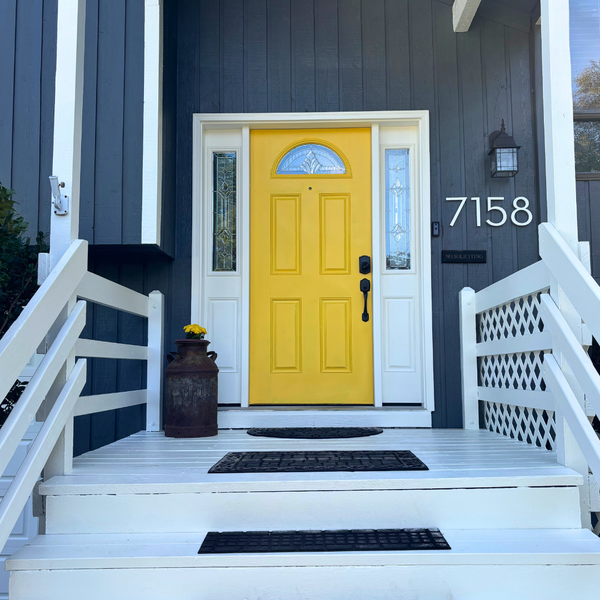
Light-colored numbers on a dark facade, or dark numbers on a light wall, achieve this separation most reliably. Material also plays a role: brushed aluminum reflects ambient light differently than painted wood or matte acrylic, which can either help or hinder readability depending on the background. For most homes, pairing a durable material like recycled aluminum with a high-contrast mounting surface delivers both longevity and legibility.
What Role Does Lighting Play in Ensuring House Numbers Are Readable at Night?
Lighting plays a critical role in ensuring house numbers are readable at night because address visibility drops sharply after sunset. The city of St. Martinville, Louisiana is considering an ordinance requiring numbers that are either illuminated at night or finished with a reflective coating, with fines of $200 plus court fees for noncompliance (InterNACHI).
Homeowners have several options for nighttime readability:
-
Dedicated address spotlights or uplights aimed at the numbers.
-
Backlit or halo-lit LED numbers that create a glow around each digit.
-
Reflective finishes that bounce light from passing headlights.
-
Glow-in-the-dark house numbers that collect daylight and emit it after dark without electricity or batteries.
Solar-powered and glow-in-the-dark solutions are especially practical for homes without outdoor electrical outlets. With the right lighting strategy in place, selecting the best installation approach completes the visibility equation.
What Are the Most Effective Tips for Improving House Number Visibility?
The most effective tips for improving house number visibility focus on strategic placement, proper installation, and innovative design choices. The following subsections cover optimal location selection, installation techniques for curb appeal, and modern designs that balance style with readability.
How Can Homeowners Select the Best Location for Their House Numbers?
Homeowners can select the best location for their house numbers by choosing a spot that is unobstructed and visible from both directions of street traffic. Numbers should be mounted near the front door, on a porch column, or beside the garage at a height between 4 and 6 feet, where approaching vehicles and pedestrians can identify them quickly.
Avoid placing numbers behind landscaping, under deep eaves, or in recessed areas where shadows reduce readability. For properties set far back from the road, adding a secondary address sign near the mailbox or at the driveway entrance ensures visibility even when the home itself is difficult to see. As IoT-enabled location tracking improves emergency coordination, according to IEEE Public Safety Technology, clearly positioned physical numbers remain essential as a reliable backup when digital systems fail.

What Installation Techniques Help Maximize Curb Appeal and Functionality?
Installation techniques that help maximize curb appeal and functionality include using concealed mounting hardware, proper spacing, and level alignment. Floating mount systems, where numbers stand off the wall by half an inch or more, create shadow lines that improve contrast and add architectural depth.
Key installation best practices include:
-
Spacing numbers evenly, typically 1 to 2 inches apart, to prevent visual crowding.
-
Using a drilling template for precise hole placement and consistent alignment.
-
Mounting into solid substrate material such as wood, stucco, or masonry for long-term stability.
-
Sealing mounting points with exterior-grade caulk to prevent moisture intrusion behind the numbers.
For most homeowners, the standoff mounting method delivers the strongest combination of visual impact and legibility, making it a worthwhile upgrade over flat-mounted alternatives.
Are There Innovative Designs That Enhance Both Style and Visibility?
There are several innovative designs that enhance both style and visibility, including backlit LED house numbers, solar-powered illuminated signs, and app-controlled smart address plaques. These options provide consistent nighttime readability while complementing modern home architecture.
Other design innovations worth considering:
-
Brushed or powder-coated aluminum numbers that resist fading and maintain high contrast over time.
-
Vertical address plaques that create a distinctive look while keeping numbers at an optimal viewing height.
-
Dual-finish designs pairing matte backgrounds with reflective characters for day-and-night legibility.
Choosing a design that integrates illumination or reflective properties eliminates the most common visibility failure point: darkness. With the right combination of material, finish, and lighting, address numbers serve as both a functional safety feature and a design statement.
How Do High-Quality, Modern House Numbers Contribute to Home Design and Value?
High-quality, modern house numbers contribute to home design and value by elevating curb appeal, signaling architectural intentionality, and using durable materials that justify long-term investment. The following sections cover why architect-designed numbers are worth the investment and how sustainable materials meet contemporary preferences.
Why Are Architect-Designed and Handcrafted Numbers an Investment for Homeowners?
Architect-designed and handcrafted numbers are an investment for homeowners because they combine design expertise with durable construction, adding measurable curb appeal that distinguishes a property. Mass-produced alternatives often lack the precision, material quality, and aesthetic cohesion that professionally designed address signs deliver.
Handcrafted numbers made from solid, recycled aluminum offer longevity that cheaper alternatives cannot match. When every detail is designed by architects and built to order, the result complements a home's architectural style rather than detracting from it. For most homeowners, upgrading address signage is one of the highest-impact, lowest-cost exterior improvements available.

How Do Sustainable Materials Align with Contemporary Design Preferences?
Sustainable materials align with contemporary design preferences by meeting growing homeowner demand for eco-conscious products that do not sacrifice style. According to Modulex, manufacturers are increasingly offering house numbers made from recycled aluminum, reclaimed wood, bamboo, and biodegradable plastics to reduce environmental impact.
This shift reflects broader trends in residential design, where material sourcing matters as much as aesthetics. Recycled aluminum, for example, delivers the clean lines and weather resistance that modern architecture demands while minimizing resource extraction. Choosing sustainable address signage allows homeowners to express environmental values through a visible, everyday design element on their property's exterior.
With design and sustainability working together, the right address sign becomes a practical way to enhance both appearance and property perception.
How Can Modern House Numbers Help You Choose and Install the Ideal Address Sign for Your Home?
Modern House Numbers helps homeowners choose and install the ideal address sign by combining architect-designed craftsmanship with practical visibility guidance. The subsections below cover available services and key article takeaways.

What Services and Support Does Modern House Numbers Provide for Selecting and Installing Address Signs?
Modern House Numbers provides architect-designed, handcrafted address signs made from solid, recycled, ⅜" thick aluminum in Tucson, Arizona. Every order includes personalized drilling templates, step-by-step installation instructions, and concealed hardware for a worry-free, professional result.
Choosing the right sign means balancing visibility requirements with design preferences. According to Modulex, manufacturers are increasingly offering address signs made from sustainable materials, including recycled aluminum, reclaimed wood, bamboo, and biodegradable plastics to reduce environmental impact. Modern House Numbers aligns with this shift, using recycled materials and made-to-order production that minimizes waste.
Modern House Numbers offers multiple product lines to match diverse needs:
-
Custom numbers and letters starting at $24.50, available in several font styles.
-
Address plaques starting at $64.50 for a complete, unified look.
-
QuickShip options starting at $28.50 for faster delivery.
-
Mailbox decals and curb stencils for additional visibility points.
-
A dedicated trade program for architects, builders, and contractors.
For homeowners unsure about sizing or placement, Modern House Numbers’ responsive customer support team provides guidance within 24 hours. Proper installation height and unobstructed sightlines remain critical; as Jefferson County, Washington requires, address signs should be posted at least three feet above the roadway with surrounding vegetation maintained so plants do not obscure them.
What Are the Key Takeaways About Do You Need A House Number? Importance & Visibility Tips We Covered?
The key takeaways about house number importance and visibility are that visible address numbers are legally required in most U.S. jurisdictions, essential for emergency response, and directly tied to curb appeal and property value.
Here are the most actionable lessons from this guide:
-
Check your local building code for minimum number height, stroke width, reflective finish requirements, and approved mounting locations.
-
Choose numbers at least 4 inches tall with high contrast against the background surface for readability from the street.
-
Use reflective or illuminated finishes to ensure nighttime and poor-weather visibility.
-
Mount signs in unobstructed locations visible from both directions of street traffic, and keep landscaping trimmed around them.
-
Consider sustainable, durable materials like recycled aluminum that withstand years of weather exposure.
Investing in a well-designed address sign is one of the simplest upgrades a homeowner can make. It satisfies legal requirements, supports faster emergency response, and elevates the look of any home. Modern House Numbers makes this process straightforward with architect-designed products, sustainable materials, and installation support included with every order.